The water looks ordinary until it doesn’t. A dark shape, seventeen feet long by some estimates, glides just beneath the surface of Loch Ness and begins to turn, and turn, and turn—slow, hypnotic circles in the gray Scottish light. On a grainy hotel webcam feed, the world’s most famous cryptid seems to be tracing a private ritual in the depths, and once again, the old folklore has pulled itself into the present news cycle.
Latest Sightings
The newest wave of Loch Ness Monster buzz centers on footage recorded from a fixed webcam overlooking the loch, operated near the Clansman Hotel, a regular vantage point for Nessie enthusiasts and researchers alike. In late September 2025, veteran watcher Eoin O’Faodhagain reported observing a brown-black form, estimated at about seventeen feet in length and roughly five feet wide, break the surface and engage in a continuous circling motion near mid-loch. According to the detailed write-up on Weird Darkness, he described the mass as dark as decomposed wood and saturated peat, moving in a way that did not match local boat traffic, known fish, or surface debris.
What made this sighting stand out in a crowded field of Nessie clips was not just the size of the object, but its behavior. O’Faodhagain noted that the creature’s movement was not linear, predatory, or obviously mechanical. Instead, it seemed locked into a tight, repeated track, spiraling almost like a slow biological whirlpool. Weird Darkness points out that this circling pattern closely mirrors footage captured in 1992 and later preserved in a documentary about Loch Ness, where another unexplained dark mass performed near-identical circular motions in the same body of water. For believers, this is the tantalizing suggestion of a consistent animal behavior; for skeptics, it is a challenge to find a repeating, non-biological explanation that fits the pattern.
The timing of the sighting is significant. The official Loch Ness Monster sightings register has reported an uptick in webcam-based reports in recent years, driven by more cameras, better connectivity, and a growing community of online watchers who treat the loch like a 24/7 livestreamed laboratory. While many entries are later attributed to waves, wakes, or birds, a smaller subset, including this new circling object, resists easy categorization and becomes fodder for further research and debate.
Beyond the webcam, there have also been anecdotal reports from boat operators over the summer describing sudden, localized disturbances and unexplained sonar hits in deeper sections of the loch. None of these, on their own, would mean much. But when a new highly publicized clip surfaces—especially one that appears to echo a decades-old behavioral pattern—it acts as a focal point for every half-remembered ripple, wake, and shadow that has ever crossed those dark waters.
Folklore and History
Long before webcams and dedicated cryptid channels, Loch Ness was already steeped in layers of folklore. The earliest often-cited written account appears in a seventh-century text about Saint Columba, which describes a ‘water beast’ in the River Ness, attacking a swimmer before being driven off by the saint’s command. Over centuries, tales of large, unsettling creatures in the Scottish Highlands merged with local beliefs about water spirits, known as kelpies or each-uisge, shape-shifting entities said to lure people to watery deaths.
The modern Nessie story, however, truly ignited in 1933, when reports of a large, whale-like animal crossing the road near the loch made their way into local newspapers. That same year, construction on a new road opened more of the shoreline to traffic, placing more eyes on the water than ever before and, in effect, turning the loch into a living stage set for twentieth-century monster lore. The famous surgeon’s photograph, published in 1934 and later debunked as a hoax involving a toy submarine, paradoxically solidified Nessie’s image: a long-necked, plesiosaur-like silhouette rising elegantly from the water, a profile recognized worldwide.
Yet local folklore rarely matches that sleek, dinosaur-like image. Many Highland stories speak instead of rolling humps, dark logs that move against the current, and waves with no obvious source. The cryptid is less a neat creature profile and more a shifting presence—sometimes animal, sometimes spirit, sometimes warning. The new circling footage, with its indistinct dark mass rather than a neat neck and head, arguably fits that older, more amorphous tradition.
In that sense, each new sighting does more than add another data point; it feeds a folk narrative several centuries in the making. Nessie is a character in an ongoing story told by villagers, boat captains, visiting tourists, and, increasingly, by online communities who have never set foot in Scotland but feel a personal connection to the loch’s mystery.
Science, Sonar, and Serious Research
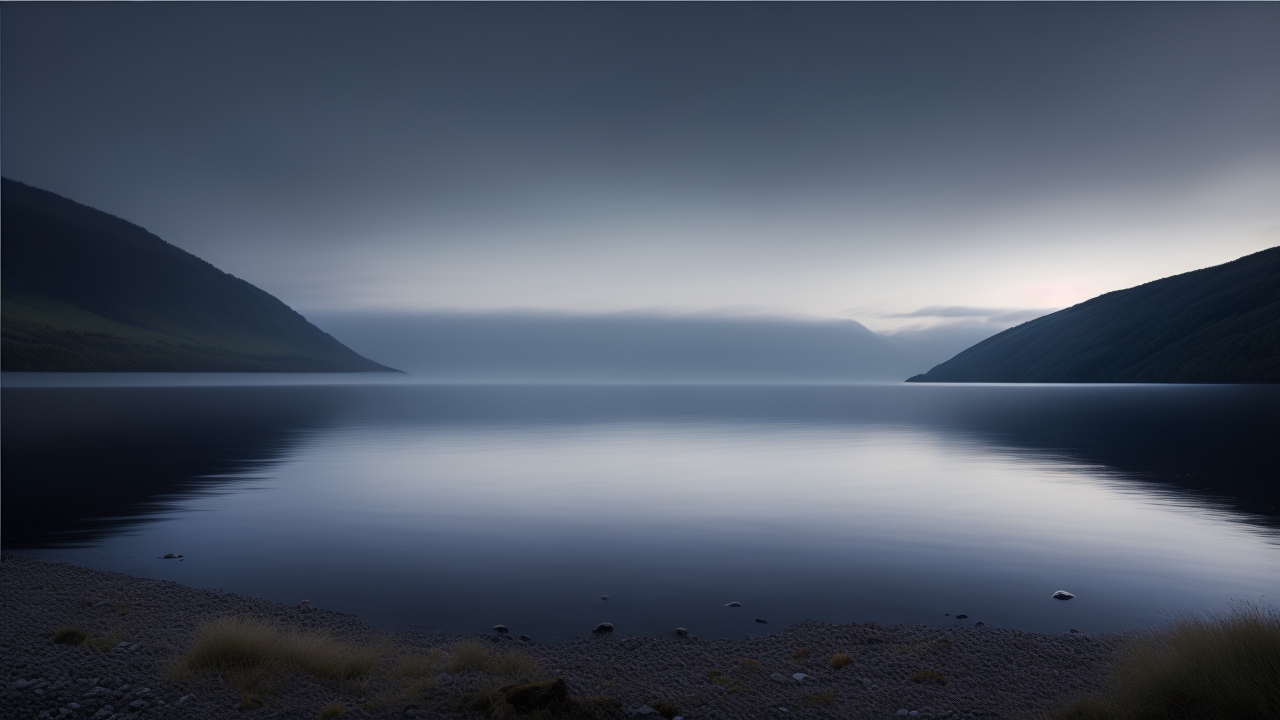
Loch Ness has attracted some of the most persistent cryptid-related fieldwork in the world, from amateur expeditions to academic surveys. The loch’s physical properties alone invite speculation: it is about 36 kilometers long, narrow, steep-sided, and extremely deep, with a maximum depth over 230 meters. Its peaty water is famously dark and turbid, limiting visibility and making it easy for shadows and wakes to play tricks on the eye.
Major sonar sweeps over the decades have largely failed to reveal any large, air-breathing animals, but they have produced puzzling readings—moving targets larger than typical fish, appearing briefly and then vanishing. In 2019, an international team led by New Zealand researcher Neil Gemmell conducted a large-scale environmental DNA study, collecting water samples around the loch to test for genetic traces of resident species. Their results, widely covered by outlets such as BBC News and National Geographic, found DNA from fish, birds, mammals, and bacteria, but no evidence for reptiles like plesiosaurs or giant unknown mammals. However, they did highlight a notable abundance of eel DNA, leading Gemmell to suggest that if a monster-like creature exists in the public imagination, it might be rooted in sightings of unusually large eels.
That eel hypothesis has gained traction in the wider discussion. National Geographic in 2020 noted that eels in European waters can theoretically grow to impressive sizes over long lifespans, although conclusive proof of a ‘super eel’ in Loch Ness remains elusive. When it comes to the new circling footage, some biologists have proposed that an eel or school of fish near the surface, influenced by local currents, could create a swirling pattern that appears larger on a distant camera. Others argue that the apparent scale and persistence of the object complicate that explanation.
Public appetite for serious cryptid research remains strong. A YouGov survey in 2023 found that roughly 27 percent of people in the United Kingdom said they believe it is at least somewhat likely that undiscovered large animals still exist in the world’s lakes and oceans, a figure that rises among younger respondents who consume a steady diet of online mystery content. For Loch Ness specifically, long-term watchers like O’Faodhagain effectively act as citizen scientists, logging dates, weather, and visual details in a way that blurs the line between enthusiast and field researcher.
Cultural Impact and Community
In cultural terms, Nessie has long since transcended her status as a local legend. She is a brand, an ambassador, a running joke, and a serious subject of fascination—all at once. According to VisitScotland economic reports cited in Scottish government tourism briefings, Loch Ness and its associated monster lore contribute tens of millions of pounds annually to the regional economy through tours, accommodation, and merchandise. Every new wave of Nessie news ripples through that ecosystem, drawing visitors who hope, at minimum, to stand where someone once saw something on the water.
The latest sighting has also energized online communities devoted to cryptids and folklore. Discussion threads dissecting the circling footage have filled with frame-by-frame analyses, homemade contrast enhancements, and speculative diagrams of currents and underwater topography. At the same time, local residents often maintain a more grounded view, seeing Nessie both as a cherished symbol and as a practical anchor for livelihoods. For them, the creature is not only a mystery but a neighbor—always present in signage, souvenirs, and storytelling.
There is also a quieter cultural dimension. In an era dominated by high-resolution satellite imagery and constant data flows, the idea that a large, unknown creature might still inhabit a well-traveled lake is oddly comforting to many. A Pew Research Center survey in 2024 found that about 45 percent of respondents in the United States agreed with the statement that ‘some mysteries of nature should remain unexplained,’ even when technology could probably resolve them. Nessie, in that light, functions less as an animal to be cataloged and more as a shared symbol of what we do not yet fully grasp.
The monster’s influence extends into environmental awareness. Conservation groups have used the global fascination with the cryptid to highlight freshwater ecosystem health, reminding visitors that whatever lives—or does not live—in Loch Ness depends on the same water quality that sustains otters, fish, and bird life. This framing turns monster hunting into a gateway to ecological literacy, connecting folklore with science in a way that feels accessible rather than didactic.
Why It Matters Today
On the surface, another blurry shape in a distant lake webcam might seem trivial in a world full of urgent headlines. Yet the renewed attention to the Loch Ness Monster in 2025 speaks to something deeper in how we relate to the unknown. The convergence of folklore, digital media, and amateur research is creating a new kind of participatory mystery—one where thousands of people can sit at home and watch for anomalies on a live feed, then debate them together in real time.
For the cryptid community, the circling footage is more than entertainment. It is a shared puzzle piece that sits alongside decades of stories, sonar traces, and cultural images. Whether viewers lean skeptical or hopeful, they are participating in a longstanding human habit: turning strange ripples at the edge of perception into narrative. The fact that this narrative now unfolds on social platforms and video analysis apps does not make it less traditional; it simply relocates the village fireside to a global, digital commons.
There is also a methodological lesson in how this story is unfolding. The latest sighting is not treated as definitive proof, but as another data point to be examined against weather records, boat schedules, and known animal behavior. In that sense, it models a healthy middle path between credulity and dismissal. The mystery is allowed to breathe, but it is also pressed, gently, with questions.
Practical Takeaways for Curious Readers
- If you visit Loch Ness, treat it like a field site. Bring binoculars, a notebook, and a healthy respect for the weather. Record times, conditions, and directions if you see anything unusual; even if it is just a boat wake, you are practicing the same observational habits that underpin real research.
- Engage with folklore as data, not just decoration. Local stories about water horses, dark humps, or lake spirits may not be literal descriptions of a cryptid, but they can preserve patterns of experience over generations. Listening to them closely can reveal how communities have historically made sense of strange encounters with nature.
- Stay skeptical but open-minded online. When new Nessie footage appears, look for multiple angles: has anyone checked boat logs, weather, or known animal activity? Thoughtful skepticism keeps the mystery alive in a meaningful way, rather than draining it of wonder or turning it into unquestioned belief.
- Use the monster as a doorway into ecology. Learning about eel life cycles, sonar technology, or peat-stained water transparency not only grounds the legend in real-world context but also deepens appreciation for the loch as an ecosystem, not just a backdrop for a single creature.
- Participate respectfully in the global community. Whether you share your own lakeside photos or contribute to online discussions of new sightings, remember that behind every viral clip are real places and people. Approach both with curiosity, humility, and a willingness to listen.
A Living Story in Dark Water
Somewhere between the old saint’s tale and the newest pixelated webcam footage, the Loch Ness Monster has become less a question of ‘Is it real?’ and more a question of what we choose to do with enduring uncertainty. Each time a dark shape turns slow circles beneath the surface, we are invited, again, to decide how much room we will leave in our lives for unresolved questions—for cryptids that refuse to step neatly into the frame, for folklore that will not be pinned down by a single explanation.
The latest sighting, with its strange, repetitive motion, may one day be conclusively explained as a quirk of current, wildlife, or optics. Until then, it functions as a meeting point: between science and story, between locals and visitors, between solitary late-night watchers and a sprawling online community trading screenshots across time zones. If you have ever felt that tug toward a half-seen shape at the edge of the known world, this is your invitation to join the conversation: share your thoughts, your questions, and, if the opportunity ever arises, your own careful observations from the shore of a deep, dark lake where the mystery is still very much alive.