
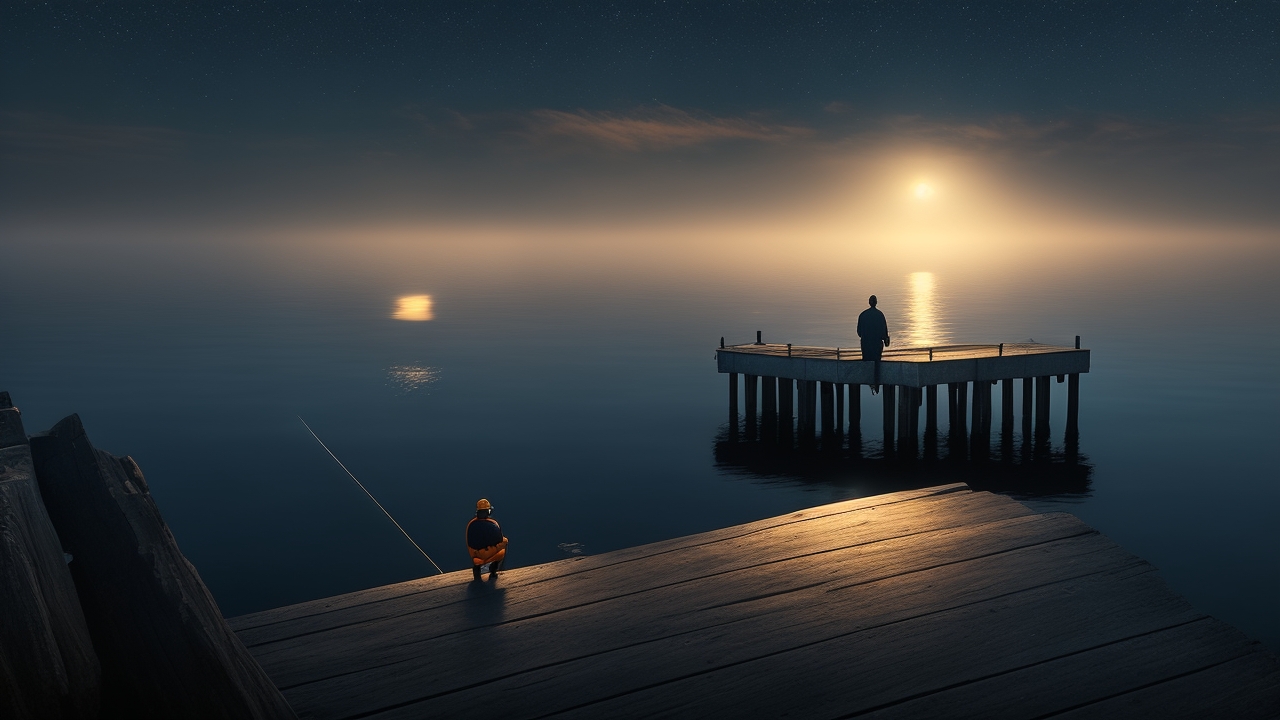
They appear where the land gives up and the deep begins: lights skimming low over black water, objects plunging into the sea without a splash, strange shapes pacing boats in the dark. For decades, UFO stories belonged mostly to the skies. Now the frontier has shifted to the shoreline.
This week’s ‘alien of the week’ is not a single being, but a pattern: an emerging wave of coastal and underwater UFO reports that is quietly reshaping how researchers, governments, and ordinary witnesses think about the extraterrestrial question.
The New Hotspot: Where Water Meets the Unknown
If you follow UFO chatter these days, you’ll notice a repeated phrase: ‘near the water.’ Beaches, harbors, offshore shipping lanes, quiet lakeside towns. That’s where the most interesting reports are clustering.
According to Marine Technology News, the Enigma UFO reporting app logged over 9,000 sightings in the United States by August 2025 within just 10 miles of shorelines and major waterways, a surprisingly dense band of activity wrapped around the coasts and river systems. Roughly 1,500 of those reports specifically mentioned terms like ‘water,’ ‘ocean,’ ‘lake,’ or ‘beach,’ and about 500 occurred within 5 miles of a coastline. Those numbers suggest that nearly one in five sightings in their 2025 dataset has some direct relationship to water.
Another layer of data comes from a Fox affiliate news report in November 2025, where a UFO tracker described thousands of unidentified submerged objects, or USOs, recorded along U.S. coastlines. In that segment, an expert raised national security concerns about these objects maneuvering in and out of the water in ways that do not match known aircraft or conventional submarines.
For a community long used to looking up, the message is clear: more and more of the mystery is moving down — to the sea’s surface and below.
Why the Coastlines Are Lighting Up
On paper, the coastal UFO surge could have mundane explanations. Coastal regions are busy: shipping traffic, cruise liners, small aircraft, drones, military training routes, offshore wind projects, and bright city light reflecting off clouds. The more activity and people you have, the more chance you’ll generate both unusual sights and human witnesses.
But the pattern is not just about raw numbers. It’s about behavior described in the reports. Witnesses are filing detailed accounts of lights that seem to emerge from the ocean, craft that descend into the water without the expected splash or steam, and objects tracking vessels at strange angles and speeds before vanishing below the waves.
Enigma’s coastal data tells part of that story: reports clustered along major shorelines do not simply describe stars mistaken for planes or distant ship lights. Many contain consistent language about abrupt direction changes, silent hovering over water, and sharp dives into the sea. Marine Technology News highlighted how a meaningful fraction of those 1,500 water-related sightings describe objects transitioning between air and water in startling ways, blurring the line between UFO and USO.
For some, that raises a provocative possibility: if an extraterrestrial intelligence were studying Earth, the oceans — which cover over 70% of the planet and are sparsely monitored compared to the skies — would be an efficient place to hide and observe. That remains speculation, but the trend has become strong enough that serious researchers now treat the water’s edge as one of the most valuable frontiers for new data.
From Fringe to Briefings: Governments Take Notice
For years, talk of underwater aliens was relegated to the absolute fringe of UFO culture, overshadowed by more traditional flying saucer narratives. That separation is fading.
Government interest in unidentified objects — now often labeled UAP, for Unidentified Anomalous Phenomena — has steadily expanded to include objects that move not only through the air, but also in or near bodies of water. When a Fox news segment highlights thousands of anomalous coastal tracks and brings on an expert openly discussing national security risks, it shows just how far this conversation has shifted into mainstream policy territory.
Analysts emphasize that ‘unidentified’ does not automatically mean extraterrestrial. Many coastal tracks could be unregistered drones, classified vehicles, sensor glitches, or misinterpreted natural phenomena. But as more coastal data accumulates, the pressure grows on defense agencies to distinguish between human-made craft, natural events, and something else entirely.
Behind the scenes, some researchers are quietly lobbying for more integrated monitoring at the air–sea boundary: combining maritime radar, sonar, satellite data, and civilian reports into a single continuous picture. Their hope is that, by lifting the veil on the oceans a bit more, they can either explain away most of these UFO reports — or isolate the truly anomalous core.
Alien of the Week: The ‘Littoral Visitor’
If we had to give this trend a creature-like nickname for our alien of the week, we might call it the littoral visitor — borrowing the term ‘littoral’ from coastal marine science. This alien is not a specific being, but an evolving portrait built from thousands of overlapping sightings at the water’s edge.
In the composite sketch, the littoral visitor tends to appear as a small to medium-sized luminous object, often white, orange, or bluish. It may hover low over the ocean, track along the coast parallel to the shore, or descend rapidly toward the water before vanishing. At close range, witnesses sometimes describe a structured craft with a dark body and distinct lights; at a distance, just a moving point of radiance.
Its most intriguing behavior is the apparent ability to tax the border between air and water with little fuss: plunging in, popping out, or skimming the surface. In some reports, fishermen speak of a quiet hum as an object tracks alongside their boat, the water unperturbed. In others, people watching from a beach describe a silent luminous object sliding into the sea as if into a doorway.
Is this truly an extraterrestrial technology, some advanced drone we have not admitted publicly, a misreading of more ordinary lights at sea, or a trick of perspective and expectation amplified by the current disclosure climate? Each possibility carries different implications, from breakthrough physics to more grounded concerns about unidentified human-made vehicles operating near critical coastlines.
What the Data Can — and Cannot — Tell Us
Recent statistics are helpful, but they do not close the case. The Enigma app’s 9,000 coastal-adjacent sightings show where people are noticing things, not necessarily why those things are there. Self-selection bias is strong: UFO enthusiasts cluster around such apps, and some locations are better connected than others. Nevertheless, when you see thousands of separate reports referencing similar behaviors near water, the pattern is hard to ignore.
Information Is Beautiful, which has visualized UFO sighting datasets across the United States, has shown that sightings fluctuate by season and geography, with some states and months producing more reports than others. Their work underscores a key challenge: UFO statistics are as much about human behavior — when people go outside, where they live, what they are primed to notice — as they are about whatever is actually in the sky or sea.
Researchers trying to get beyond the noise are pushing for tighter standards: timestamped videos, multi-sensor corroboration (such as radar and infrared alongside phone footage), and independent analysis of raw data. As one investigator quoted in Marine Technology News suggested, future progress on coastal UFOs will likely depend on partnerships between everyday witnesses, tech platforms, oceanographers, and defense analysts.
In the meantime, the littoral visitor remains an enigma: a composite alien made of numbers, human testimony, and a restless sense that something strange may be unfolding just off our familiar shores.
How to Be a Smart Witness at the Water’s Edge
If this new frontier of UFO and USO sightings has a silver lining, it is that ordinary people — beachgoers, sailors, dock workers, coastal residents — can contribute directly to meaningful extraterrestrial research. You do not need a lab or a security clearance, only curiosity, discipline, and a few practical habits.
- Document, then interpret. If you see something odd over the water, start by recording clear evidence before deciding what it might be. Use your phone’s video, keep your hand steady, and let the object stay in frame as long as possible. Narrate the time, direction, and what you are doing, but avoid speculating in the moment. Raw, unembellished footage is far more valuable to the research community than dramatic commentary.
- Anchor your sighting in context. As soon as you can, write down details: exact time, approximate location, weather, tide or wave conditions, and any aircraft, ships, or drones visible nearby. Note how the object moves relative to fixed landmarks like piers, buoys, or buildings. This information helps analysts rule out common explanations like aircraft flight paths, ship lights, or planetary alignments, and makes your report stand out as more credible.
- Share with both skeptics and specialists. If you decide to report a UFO or USO, send it to at least one established reporting platform or researcher who encourages critical review. Discuss what you saw with grounded, skeptical friends as well as enthusiasts in the UFO community, and be open to prosaic explanations. The healthiest culture of extraterrestrial inquiry is one where witnesses feel respected, but where extraordinary claims are stress-tested rather than simply believed or dismissed out of hand.
From Deep Seas to Deep Questions
This new wave of water’s-edge sightings pulls on something primal: humans have always seen the oceans as both cradle and mystery. It is fitting that, in a century obsessed with space, we are being nudged to look again at the dark surface of our own world — and to admit how much we still do not understand.
Whether the littoral visitor turns out to be evidence of aliens probing our coasts, unacknowledged technologies, exotic natural phenomena, or a mirror held up to our own expectations, it is already performing an important function. It is forcing disparate groups — scientists, sailors, pilots, policymakers, and ordinary beach walkers — into an uneasy, creative conversation about evidence, belief, and the boundaries of our knowledge.
If you find yourself standing at the shoreline at dusk, watching a strange light dance over the water, you will be part of that story. You may become one more data point in a growing archive, or you might end up convincing yourself it was just a distant ship or a trick of refraction. Either way, your attention matters. It is how the unknown becomes a map instead of a rumor.
So consider this an invitation. If you care about UFO mysteries and the possibility of extraterrestrial visitors, lend your eyes and your honesty to this emerging frontier. Join the community of careful observers, thoughtful skeptics, and curious storytellers comparing notes about what moves where the land ends. The next time something impossible glides in silence across the water, the way we respond — together — may determine whether it remains only a tale told on the pier, or the clue that finally moves the conversation forward.